top of page
Search

(June 30, 2023) Some 200 of the 650


B’nei Menashe of Manipur who have fled their homes because of the Meitei-Kuki violence of the past two months are now in northern Mizoram – over 40 families in a government-run displaced persons camp in the location of Thingdawl and another 15 families in the nearby town of Kolasib. Some have come directly from Manipur. Others have been relocated from Aizawl, where they initially sought shelter.


This week, a Degel Menashe delegation made the 4-hour drive from Aizawl to the Kolasib-Thingdawl area in order to visit the refugees and determine what aid they required. The delegation consisted of six people: two, Jessica Thangjom and volunteer Rachel Garrick from Israel; four, Asaf Renthlei, Leah Renthlei, Ben Aryeh Chenkual and local B’nei Menashe Council treasurer Nadav Hranglientawna, from Aizawl; and Ohaliav Haokip, general secretary of the BMC in Manipur, from Churachandpur. Here, with input from Asaf, is Jessica’s preliminary report.


The team with the local Kolasib B'nei Menashe community members at their synagogue.

Rachel and I landed at Aizawl’s Lengpui airport on a flight from New Delhi on Tuesday morning, June 27, where we were met by Asaf, Leah, Ben Aryeh, Nadav, and Ohaliav. From there we set out directly in a three-car convoy for Thingdawl. With us we took a few simple gifts for the children in the Thingdawl camp: notebooks, crayons, and pencils with sharpeners and erasers, and some sweets and fruit juice.


We arrived at Thingdawl at about 4 p.m. Despite it being the week of the year’s longest day, the light was already beginning to wane, since India has no daylight saving time and only a single time zone, at whose far eastern end Mizoram and Manipur lie. Directed to the camp by local inhabitants, we came to three two-story buildings standing on a hillside. In two of them, it was explained to us, the camp’s 300 displaced– half B’nei Menashe, and half Christian Kukis – are housed, while the third served as an administrative center and kitchen for the two daily meals that are served to the camp’s occupants.


A warm welcome at Thingdawl.

The B’nei Menashe of Thingdawl were expecting us. We were welcomed by a group of them, mainly children, and got to work at once distributing our gifts. One of the first things we noticed about the Thingdawl camp was that most of its residents were children and women. The men and older boys, we were told, had stayed behind in Manipur to help the Kuki defense effort. Over 10,000 Kukis have crossed since early May from Manipur to Mizoram, whose government was already coping with over 30,000 refugees from Myanmar fleeing the depredations of the military regime there. One must commend the Mizo government for the generous hospitality it has shown despite the strain on its resources.

A government building utilized as a relief camp.

Each of the two buildings housing refugees in Thingdawl, one of which has been set aside for the B’nei Menashe, has 13 rooms, each room holding up to four families. A communal kitchen on the ground floor serves those who would rather prepare their own food, which consists largely of rice, lentils, potatoes and vegetables procured when possible from the local market. The rooms have practically no furniture. All sleep on the floor with a thin foam mat for a mattress in the best of cases and makeshift pillows fashioned from clothes, bags, and other items. Some of the families have badly needed mosquito nets, either purchased or donated by local Mizos; some do not. Each building has a communal toilet and washing area, but water must be brought by the residents from nearby water tanks in buckets or pots and is carefully rationed.


All in all, the Thingdawl camp does not give a depressing impression. Its B’nei Menashe live in primitive but not overcrowded conditions . Each family has a corner of a room or more for itself, with cloth partitions sometimes erected for privacy, and a general sense of neatness and order prevails. The children have been enrolled by the government in local schools (though they do not speak Mizo, they pick it up quickly, since Kuki is a closely related language) and the women keep busy for much of the day cleaning, doing laundry (a never-ending task, since the same clothes must be worn and re-worn), preparing food, and fetching water.

Shacharit at the camp.

The chief needs of the camp’s B’nei Menashe residents are mattresses, pillows, and mosquito nets. We slept alongside them in a room above the cooking area the night we were in Thingdawl, and the mosquitoes buzzed around us all night, making it difficult to fall asleep and stay asleep. We woke early the next morning, groggy and reminding ourselves as we sipped out breakfast of black tea that we had just gone through a single night, while those whose mats and floors we had shared had to endure such nights one after another. As there were not enough men for a minyan, Asaf, Ohaliav, Ben Aryeh, and Nadav had to say their morning prayers individually.


That same day, we also visited the eight displaced families that have been taken in by the tiny Bnei Menashe community of Kolasib, which is a little under half an hour’s drive away. Some are staying with relatives and some have rented homes of their own, either with savings they managed to bring from Manipur or from the work that some have found in local betel plantations. Their situation is better than that of the Thingdawl residents, a program of assistance to whom might include subsidizing rentals in Kolasib. If it was a pleasure for the six of us to be able to rest and wash up in normal facilities, how much more so would it be for Thingdawl’s B’nei Menashe to be able to live that way!

Meeting with the Deputy Commissioner, Mr. John LT Sanga.

After leaving Thingdawl in the morning, escorted by the children who followed us everywhere, we met with the District Commissioner of the Kolasib region, Mr. John LT Sanga. He and Asaf had studied together in New Delhi and knew each other. An affable man with (like many Mizos and Kukis) an identification with Israel, he told us that the area is currently hosting the largest refugee population in all Mizoram, some 17,000 displaced persons having arrived in a steady stream from Manipur in the last 40 days. The previous day, in fact, had been the first in all that time with no new arrivals. When asked how long Mizoram was prepared to continue hosting the displaced Kukis, his answer was, “For as long as is necessary.”


This was reassuring, because the Thingdawl camp’s B’nei Menashe do not on the whole wish to return to Manipur. They do not feel that they have a future there. Their next destination, as far as they are concerned, must be Israel.


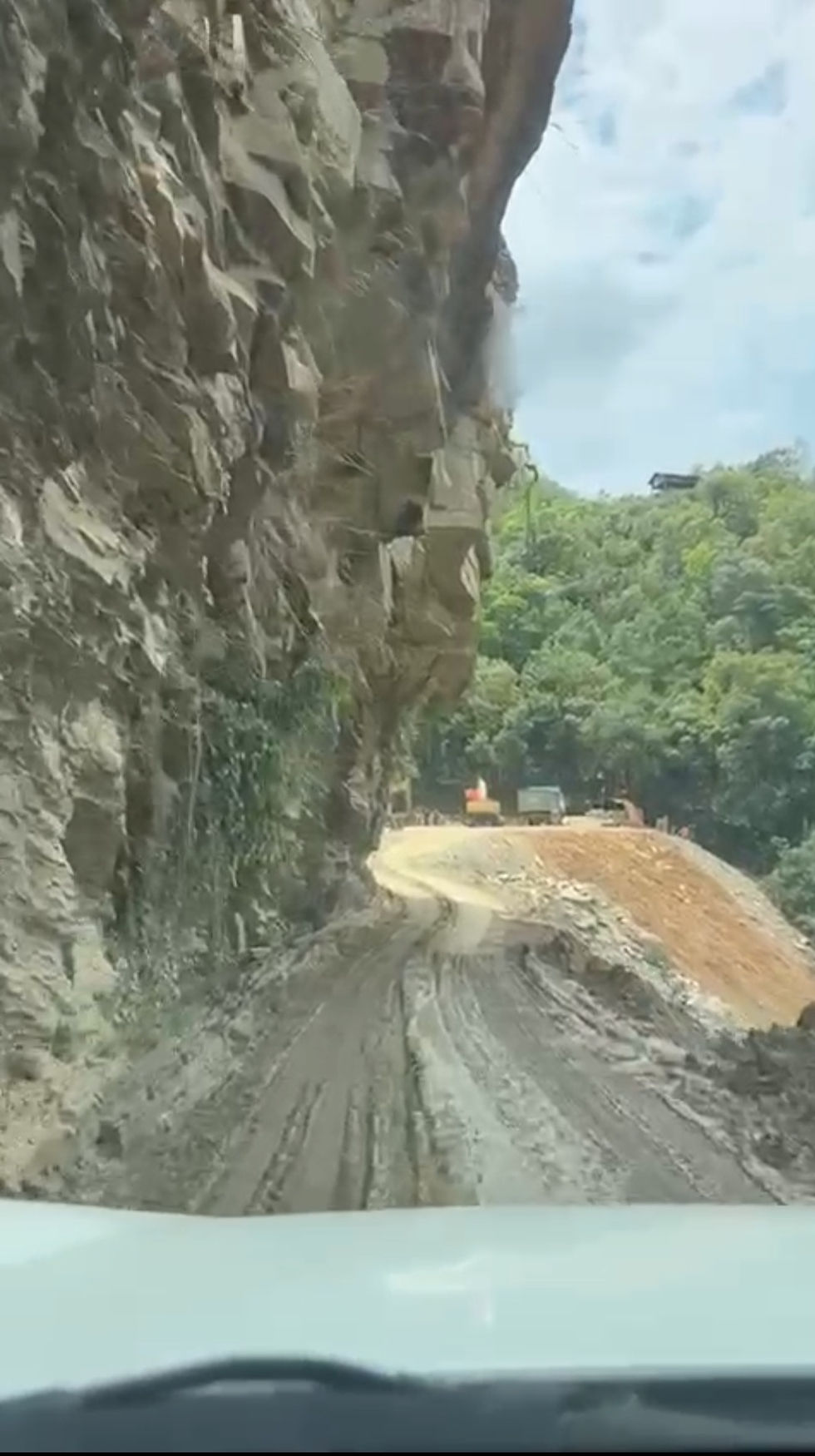
We parted from the commissioner and set out on the return trip to Aizawl, from which we planned to continue to Churachandpur. Although this might not seem to make sense when looking at a map, Kolasib being much closer to Churachandpur than is Aizawl, no passable roads lead from Kolasib northward, it already being the beginning of the monsoon season in India, when dirt roads become untraversable. A paved highway connects Churachandpur to Aizawl, and that was what we planned to take.


A glimpse inside the camp:


Updated: Dec 15, 2023

(June 22, 2023) A week ago, a Jewish boy came into the world in Mizoram. This in itself was not unusual: B’nei Menashe children are born in Mizoram and its neighboring state of Manipur all the time. All the time, too, however, they are given Hebrew names soon after birth. Liansuanlal Tungnung is still waiting for his.

The family waits expectantly for the baby's arrival.

Liansuanlal is – need we say it? – Liansuanlal’s Kuki name. His parents, Oren and Efrona Tungnung, who like most B’nei Menashe are known their co-religionists by their Hebrew names, hail from Churachandpur in Manipur, where, the parents of two small boys, they were expecting the birth of a third child in mid-June. When Kuki-Meitei ethnic conflict broke out in Manipur in early May, they felt sufficiently safe in Churachandpur – both a Kuki and a B’nei Menashe stronghold – to plan on staying there. However, as the conflict continued to escalate with no sign of abating, and Oren and Efrona’s parents in Israel sent them frantic messages pleading with them to leave for somewhere more secure, they changed their minds.


On May 11, Efrona, in an advanced state of pregnancy and with two young toddlers in tow, aged four and two-and-a-half, managed to make her way to Mizoram’s capital of Aizawl. It wasn’t simple. None of the usual drivers plying the 16-hour Churachandpur--Aizawl route that winds through mountain roads wanted to hazard the trip, and renting a car by itself would have cost the young couple an inflated price of 40,000 rupees or $500, an enormous sum by Indian standards. Only when they found fellow townsmen eager to make the same trip were they able to afford the cost of a shared vehicle – and even then they had to pay several times more than tit would have cost them before the troubles broke out.


Why did Oren not join his family at this critical juncture? Because at the time a rumor was making the rounds in Manipur that able-bodied Kuki young men were not being allowed by Kuki village volunteers to leave the state, being needed for the fight against the Meiteis. Since all Internet services had been suspended in Manipur and reliable information was at a dearth, there was no way to corroborate or disprove this rumor and the Tungnungs decided it was best no to risk Oren’s possible arrest and detention for desertion.


Yet once Efrona informed her husband that she had safely reached Aizawl, and the worrisome rumor remained unsubstantiated, Oren decided to head for Aizawl come what may. Unlike others he was traveling with, who managed to obtain certificates of safe passage from their local community associations, he boldly boarded the vehicle armed with nothing but the assertion that he was rejoining his family. Nor was there a seat for him. The van transporting him was jam-packed, with three passengers instead of two in the front seat, six instead of four in the middle row, and four more in the last row, half-perched on the travellers’ luggage. Two more men were given space on the baggage rack on the roof.


One of the two was Oren, who literally clung for dear life to the bars of the rack as he was jounced up and down on the twists and turns in the bumpy road climbing to Aizawl. Sleep was out of the question. The lucky thing was that it didn’t rain, it being just before the start of the monsoon season. The ride on the roof cost Oren 2,000 rupees.


On May 13, Oren reached Aizawl. For several weeks he, Efrona, and their two boys stayed in makeshift quarters in the city’s B’nei Menashe Council-run Shlom Tsion synagogue, counting the days until Efrona gave birth. Then, with the help of BMC leader Ben Aryeh Chenkual, who briefly put them up at this residence, they rented an Aizawl apartment paid for by Efrona’s parents. “It was a privilege to be able to extend hospitality to our brethren from Manipur,” Chenkual told our Newsletter. “We’re only sorry that we didn’t see the wave of B’nei Menashe displaced from Manipur coming in time to prepare for it better.”


On June 13, the same day that Efrona was finally admitted to the maternity ward of the government-run Aizawl Civil Hospital, Oren and the two boys moved into the apartment. B’nei Menashe activist Leah Renthlei tended to Efrona from her beside while she awaited labor and concomitantly, Amina Lhouvum, a young lady and former neighbour in Churachandpur now living in a refugee camp in northern Mizoram was brought to Aizawl to assist the young couple when their new child was born.


Finally, on Thursday, June 15, at half-past-four in the afternoon, a beautiful baby boy, Liansuanlal Tungnung,

Proud mother Efrona with newborn, Liansuanlal.

was born. What about a Hebrew name, which every B’nei Menashe has – which is indeed a badge of B’nei Menashe identity? Although Oren and Efrona have decided on one, they were determined to keep it themselves until Liansuanlal’s circumcision, since the Jewish custom is not to announce a newborn boy’s name until then – and a date for the circumcision, which did not take place on the eighth day after birth per Jewish practice, has yet to be set.


Why is this? The reason is that in all of Mizoram there is no mohel or ritual circumciser, the local community being too small to sustain one. Traditionally, either a mohel has been brought from Manipur, where there are several, or else the procedure has been performed by a physician -- and in this case, neither has been possible: the disturbances in Manipur have kept mohalim from traveling to Mizoram and Mizoram physicians are squeamish about performing what they consider an “elective procedure” on little babies. B’nei Menashe boys born in Mizoram who are not circumcised by a mohel from Manipur generally have to wait to have it done until the age of five to seven.


Do many B’nei Menashe boys in Manipur, then, have no Hebrew name until they are five or more years old? No, because in Mizoram B’nei Menashe parents do not wait that long to announce such names. Even if circumcised by a doctor at a later age, the boy’s Hebrew name is revealed after birth.


Well, then – to ask one last question – why don’t Oren and Efrona Tungnung adopt the Mizoram custom and announce Liansuanlal’s Hebrew name now?


Because – to give one last answer – they’re from Manipur, where the custom is to name a boy only at his circumcision.

Efrona was sent home from the hospital on June 22 and was brought along with Liansuanlal by Oren to their new apartment. “I’ve been pleasantly surprised at the warm welcome that our family has received from the local community in Aizawl,” she says, “and I appreciate all their efforts and the love they have shown us.” Meanwhile, only they know Liansuanlal’s Hebrew name. It will not be made public until a mohel can arrive from Manipur, which will hopefully be sometimes this summer.


(June 15, 2023) While peace talks went nowhere, the Meitei-Kuki conflict continued unabated in Manipur this week, with fighting flaring up in several places along the border between the state’s Meitei-dominated central valley and its Kuki-dominated hills. In one of these locations on the valley’s north side, a village of several thousand inhabitants whose name we were asked not to disclose, lives a small B’nei Menashe community. Our Newsletter spoke this week with one of its members. Here is our conversation.


Your village has been on the front line for many weeks now. How many of its residents have fled and how many have remained?

It’s actually been about two or three weeks, because the fighting came to the north of the valley later than elsewhere. Not a single resident of the village has left. We have all decided to stay put and fight for as long and as much as necessary. This includes the B’nei Menashe community.


Do the B’nei Menashe think of this as their fight, too?

Yes. We’re Jewish but we’re also Kukis. It’s important for us to show solidarity with our brothers. In terms of men and material, we’ve participated and contributed all we can. Our B’nei Menashe youngsters take part in guarding and defending the village along with the other volunteers. It’s our duty to stand with our fellow villagers. If the village is overrun, we’re not going to be treated any differently by the Hindu Meiteis because we’re Jews rather than Christians like our neighbors.

There have been so far many attacks on our village but we’ve been able to turn them all back. The Meiteis come in force, in the hundreds and sometimes more. I’m confident that we’ll continue to hold out.

Smokes billowing out of a burnt village, file photo.

Who are the attackers?

They’ve been led by two Meitei nationalist organizations, Arambai Tenggol and Meetei Leepun, aided by the state police and the IRB or Indian Reserve Battalion, which is a para-military group consisting mainly of Meiteis.


You mean the Manipuri state government has actually been fighting along with the Meiteis?

It’s given them logistical support. They come in armored vehicles, with sophisticated weapons and even mortars. They’ve been using drones for surveillance. We see them overhead all the time. We even managed to shoot one of them down. Since then the Meiteis have been careful to fly them from a safe distance, out of range of our guns. They’re very well equipped, far better than we are. To tell the truth, our most powerful weapon is our prayers. It’s a miracle from God that we’re still here.


How close have the attackers actually come? What damage and casualties have you suffered?

So far, they haven’t penetrated our village. The fighting has been right below us, in the valley, where there are quite a few Kuki villages. Most have been burned and destroyed. We’re on the slopes above. Our big advantage is that we’re familiar with the terrain. The Meiteis only know how to fight in large formations, which does not work well in the hills. We know just where to position ourselves in order to pick them off.

Fortunately, casualties in our village have so far been low. In the fighting last week, we estimate that at least 20 Meiteis were killed, whereas we had no dead and five wounded, one grazed by a bullet and four with minor injuries from a grenade launcher. Things could be worse. The Meiteis are not good soldiers. They’re usually drugged when they come to fight.


Drugged?

I’m telling you what I’ve heard. Look, this isn’t pleasant for anyone. The difference is that they’re far from their homes. They’re coming from somewhere else to risk getting killed, while we’re defending our lives and property. I’ve heard that they’re given drugs to boost their courage.

Map of Manipur showing lines of intensive fighting, in blue.

What about food and supplies? Have the villagers been able to work?

No, we haven’t been able to go to our rice fields. Nobody ventures beyond the perimeter of the village. It’s too risky. But we haven’t, thank God, had to worry too much about food. We’re getting it from Kangpokpi [a Kuki town to the north], from which the supply lines are open all the way up to Nagaland. There are humanitarian organizations that have seen it that we have enough rice, and I’ve been told that the Nagaland and Mizoram governments are also sending aid to the Kukis. The situation is better here than in Imphal or the valley. I’ve heard that Meitei blackmarketeers there are having a field day overcharging for basic commodities. Talk about preying on your own people! But that's what the Meiteis are like.


What kind of arms do you have?

At first we had only single-shot hunting rifles, which we put to good use. Later on, as the fighting intensified and Meitei casualties increased, we took automatic rifles from their dead. There were even Meiteis who threw them away when they fled. I can’t tell you for security reasons how many of them we have, but there are enough for whoever needs them. The same holds true for the Kuki villages near us. And we have the pumpi. It’s very effective.


What’s a pumpi?

It’s a homemade cannon, made of whatever materials we can get hold of. The barrel can be made from a simple metal water pipe or hollow metal electric post. I myself have been busy making them, which is why I haven’t been out manning the village perimeter. Since the fighting began, I’ve manufactured 11 of them. I’m now working on the 12th. It’s my latest design and will be the best one yet.


Can you tell me about it? How will it work?

I can’t reveal much about it, but I can say that it will have a longer range, carry a bigger explosive charge, and be more accurate.

Pumpi, an improvised, home-made portable cannon.

What range are we talking about?

That, too, is confidential, but the pumpi has worked well until now and this will be an improved model. One good thing about it is that you don’t need specific-caliber ammunition. It can be loaded with anything – nails, metal pellets, whatever an ordinary metal worker can provide you with.


What about the explosive charge– the gunpowder?

Take my word for it, the jungle around us has everything we need to make gunpowder. Our forefathers made it for generations and passed the knowledge on to us. The forests are our guardians: we can find in them all we need to survive, and maybe a bit more.


What about Jewish life? Have the B’nei Menashe in your village been able to conduct it normally?

It’s too dangerous for us to congregate in our synagogue. There’s a nearby village called Khoken in which Meitei infiltrators dressed in army uniforms killed three people last week and wounded more by firing on a church in which there was a prayer service. The village authorities have warned us against group gatherings that might serve as targets. There’s no coercion involved, just safety concerns. We pray and observe our Jewish rituals at home, always on high alert. Much of our free time is spent reading Psalms.


What about the future? What happens next?

This conflict will not be resolved soon. The divide is too deep and will only grow deeper because of the Meiteis’ greed for our lands. This time we were caught napping. The government is on the Meiteis’ side. I don’t know if they can actually drive us out of Manipur, but they’re going to try. Even after the Home Minister of India called for a 15-day cease-fire, they went on attacking Kuki villages. We Kukis lifted a road block from Kangpokpi to Imphal in response to the minister’s appeal, but had to re-impose it after what happened at Khoken. The Meiteis are holding peace rallies and pressing their attacks at the same time. There can’t be any trust with that kind of hypocrisy. The Meitei chief minister of Manipur, N. Biren Singh, is posing as part of the peace effort while fomenting the violence. If it’s his idea of a joke, it’s a cruel one.


Note: Shortly after this interview earlier this week, newspapers reported that 9 Meitei raiders were gunned down by Kuki village guards at a church in a Kuki village, Khamenlok in the Kuki majority Kangpokpi district. There were 10 others injured. The incident occurred between 10 p.m and 10:30 p.m on the night of 13th June. They were part of 3000 strong Meitei mobs who had come to torch Kuki villages near Saikul. The raiding party had decided to rest for the night at the abandoned church. No arms were recovered, most likely having been picked up by the village guards. According to sources, most of the dead were identified as residents of Imphal, several kilometers from Khamenlok, refuting the claims by Meiteis that they were defending their villages. As of this article going to press, there are reports of arson, unrest in the capital, Imphal.


SHARE YOUR STORY. SEND US A LETTER.

CONTACT US

Isaac Thangjom, Project Director

degelmenashe@gmail.com

CONNECT WITH US
  • YouTube
  • facebook (1)
SUBSCRIBE

© 2020 DEGEL MENASHE

bottom of page